2026: May
May is a wonderful month for me.
I love spring.
When I was younger, I trained as an ornamental horticulturist, and even though I now have a classic office job and live in the city, my heart still skips a beat whenever I’m outside and see the daffodils, cherry blossoms and magnolias in bloom, the hydrangeas starting to sprout, and the meadows and trees turning a fresh, lush green.
My friends sometimes joke that I belong in the same category as the seniors who have a thousand close-up photos of random flowers on their phones; you know the ones, right?
After a rather quiet start to the year, I’m now more than ready and incredibly excited for everything that’s to come.
My best friend has her birthday in May, and my baby is due at the beginning of May. And of course, it’s Mother’s Day too, so the timing couldn’t be more perfect.
Somehow, I can already feel that this year is going to bring a lot of change. Of course, going from being a couple to becoming a little family is already a huge transformation, but I have a feeling there is so much more to come.
We’re already making plans for some things, while others will undoubtedly surprise us along the way.
We’ll probably move house at some point this year, maybe there will be a promotion or a new job, and I’m working on this blog, who knows where it might lead? I have big plans.
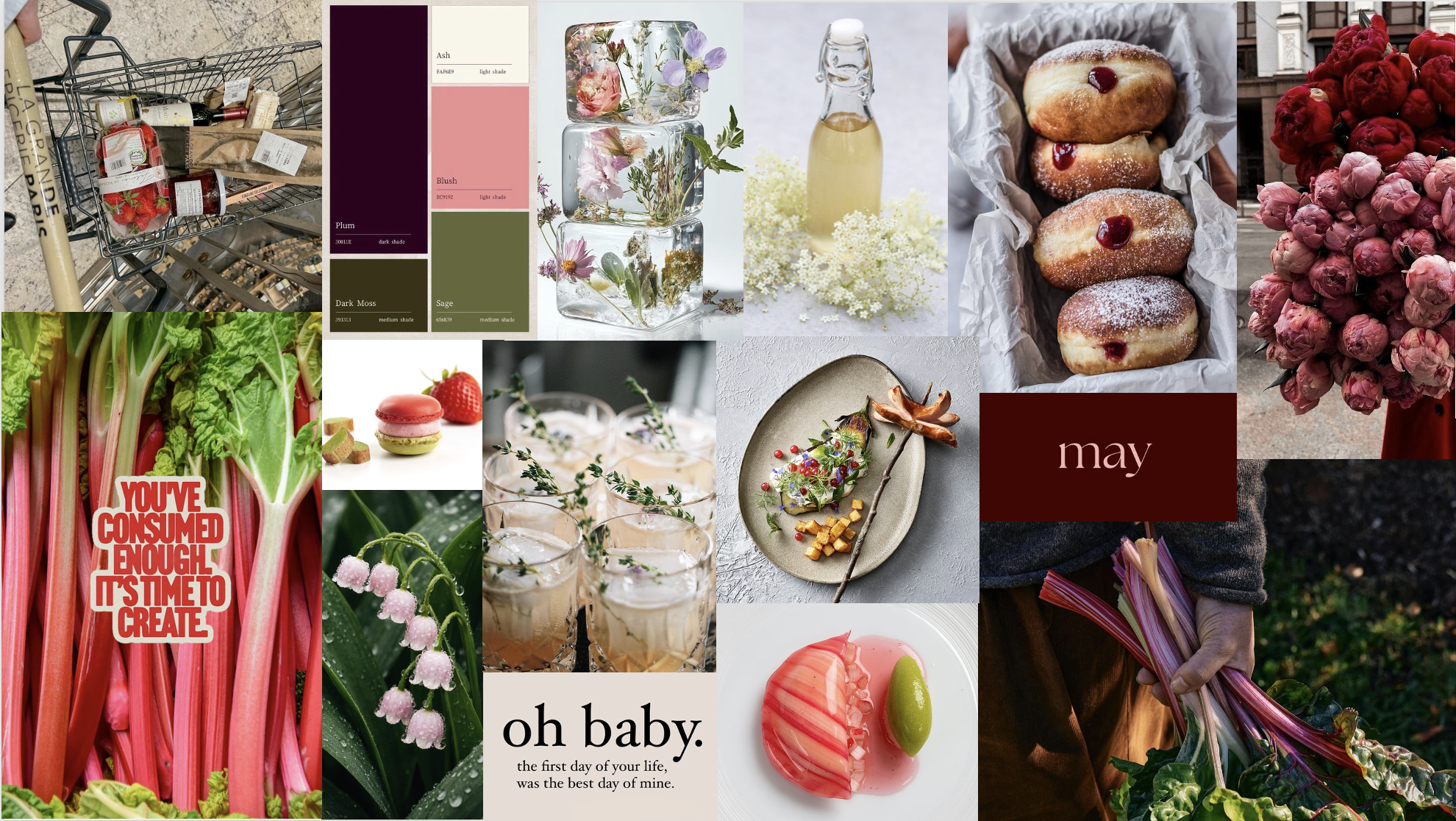
Choosing the colour palette for May was easy. For one, these are the colours we chose for pretty much everything for our baby — it’s a girl! — and they also happen to fit the season perfectly.
It’s the time of year for strawberries, rhubarb, Swiss chard, asparagus, peonies and fresh greenery. So naturally, I gravitated towards berry red, pink, sage and elderberry…
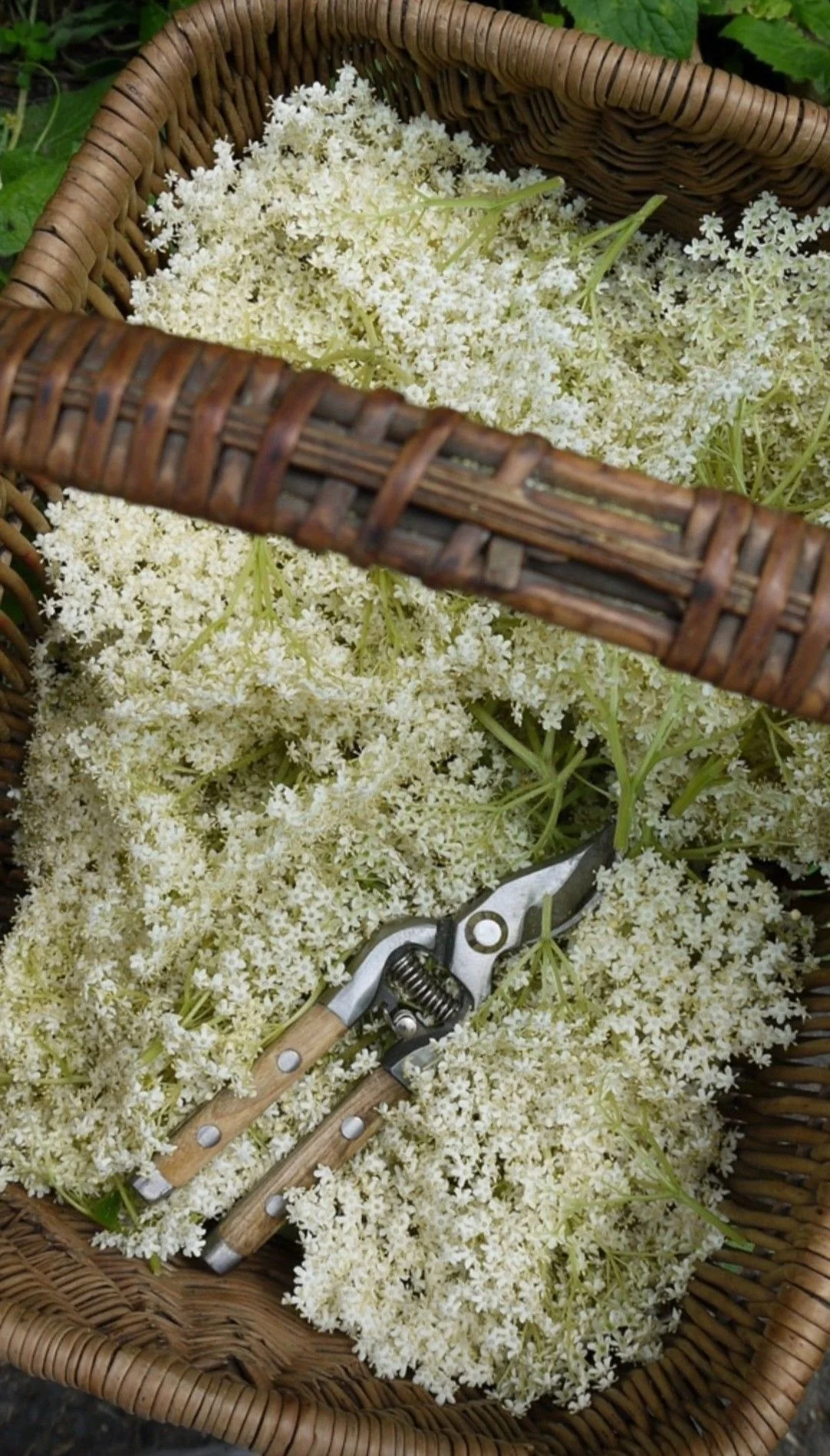
This month I found myself a bit nostalgic when I thought about elderberry, let me tell you why:
grew up in a house with six apartments. Seven of us kids lived across four of those apartments, so there was always something going on. We had a big garden surrounding the house, complete with a sandbox, swings, guinea pigs, an outdoor seating area with a pergola, and, of course, an elderflower tree.
My neighbour used to pick the elderflowers and make her own homemade syrup. She would let me watch and help her, and in return, I always got a bottle of my own.
It’s such a small childhood memory, but somehow, the taste and smell of elderflower syrup still take me straight back to that garden.
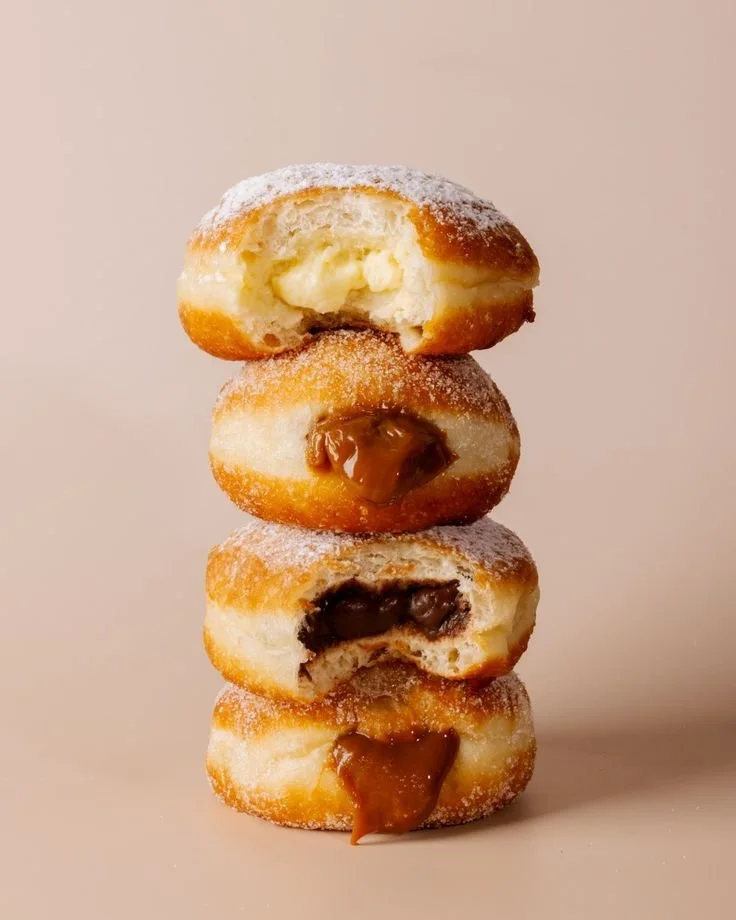
Further; With Mother’s Day just around the corner, I couldn’t resist adding a little pink sweetness to this month’s palette. While “Berliner” aren’t a traditional Mother’s Day treat, they make the perfect springtime indulgence, especially when filled with sweet, seasonal strawberries.
So here you have it:
Garden Aperitif:
Elderflower Syrup
Berliner (jam filled doughnuts)


Recipe: Elderflower Syrup
Ingredients
Makes about 1,5 - 2 liter:
20–25 large elderflower heads
1.5 litres of water
1.5 kg sugar
2 organic lemons
30–40 g citric acid
Instructions
Step 1: Pick the elderflowers. Choose a dry, sunny day and pick the flowers away from busy roads. Gently shake them to remove any insects, but avoid washing them so you keep as much of the delicate flavour and pollen as possible.
Step 2: Prepare the lemons.Wash the lemons thoroughly and cut them into thin slices.
Step 3: Make the syrup. Place the water, sugar and citric acid in a large saucepan. Heat gently, stirring until the sugar has completely dissolved. There is no need to bring it to a vigorous boil.
Step 4: Add the elderflowers. Place the elderflower heads and lemon slices in a large bowl or saucepan and pour the warm syrup over them.
Step 5: Leave to infuse. Cover and leave in the fridge for 24–48 hours, stirring once or twice during this time.
Step 6: Strain and bottle. Strain the syrup through a fine sieve or a clean muslin cloth. Heat it once more, then pour into sterilised bottles while still hot and seal immediately.
Step 7: Store. Keep the unopened bottles in a cool, dark place. Once opened, store in the fridge.
Serving suggestion
For a refreshing Elderflower Spritz, mix the syrup with Prosecco and sparkling water, then serve over ice with a slice of lemon or lime and a few fresh strawberries.
Recipe: Berliner
Ingredients
For the dough:
20g fresh yeast
200ml milk (luke warm)
40g sugar
500g flour
130g butter
1 pinch salt
1 tsp organic lemon zest (fine)
1 egg
2 egg yolk
1 tbsp lemon juice
4l neutral oil (to fry, eg. sunflower oil)
For the filling:
400g strawberry jam (or any kind you like)
6 tbsp powdered sugar (to top off)
Instructions
Step 1: Crumble the fresh yeast into a bowl and mix with 100 ml of the milk and 10 g of the sugar.
Step 2: Dust with 2 tablespoons of flour, cover and leave to rise in a warm place for 15 minutes.
Step 3: Meanwhile, beat the butter, remaining sugar, pinch of salt and lemon zest with a stand mixer fitted with the whisk attachment (or using a hand mixer) for 5 minutes, until creamy.
Step 4: Add the egg and egg yolks, one at a time, beating for about 30 seconds after each addition.
Step 5: Add the remaining flour, remaining milk, yeast mixture and lemon juice.
Step 6: Knead with the dough hook for 3 minutes.
Step 7: Cover and leave to rise in a warm place for 1½ hours.
Step 8: Turn the risen dough onto a lightly floured work surface and knead well.
Step 9: Shape into a 32 cm log and cut into 16 equal pieces.
Step 10: Shape each piece into a smooth ball by rolling it underneath your slightly cupped palm. Avoid using too much flour — the dough needs some friction with the work surface to create a smooth, tight surface.
Step 11: Place the dough balls on a floured board, leaving space between them. Cover with cling film and leave to rise for 30 minutes.
Step 12: Remove the cling film and leave uncovered for another 30 minutes. This creates a thin skin on the surface, helping the Berliner keep their shape while frying.
Step 13: Heat the oil to 170°C. Carefully lower 3–4 Berliner into the oil, top side down. Cover and fry for approximately 3 minutes.
Step 14: Turn carefully with a slotted spoon and fry uncovered for another 3 minutes.
Step 15: Remove and drain on kitchen paper.
Step 16: The combination of frying covered first and uncovered after turning creates the characteristic light-coloured ring around the centre.
Step 17: Fill a piping bag fitted with a filling nozzle with jam. Insert the nozzle into the side of each still-warm Berliner and pipe the jam into the centre.
Step 18: Dust generously with sugar and serve.
“You don’t need a silver fork to eat good food.”
